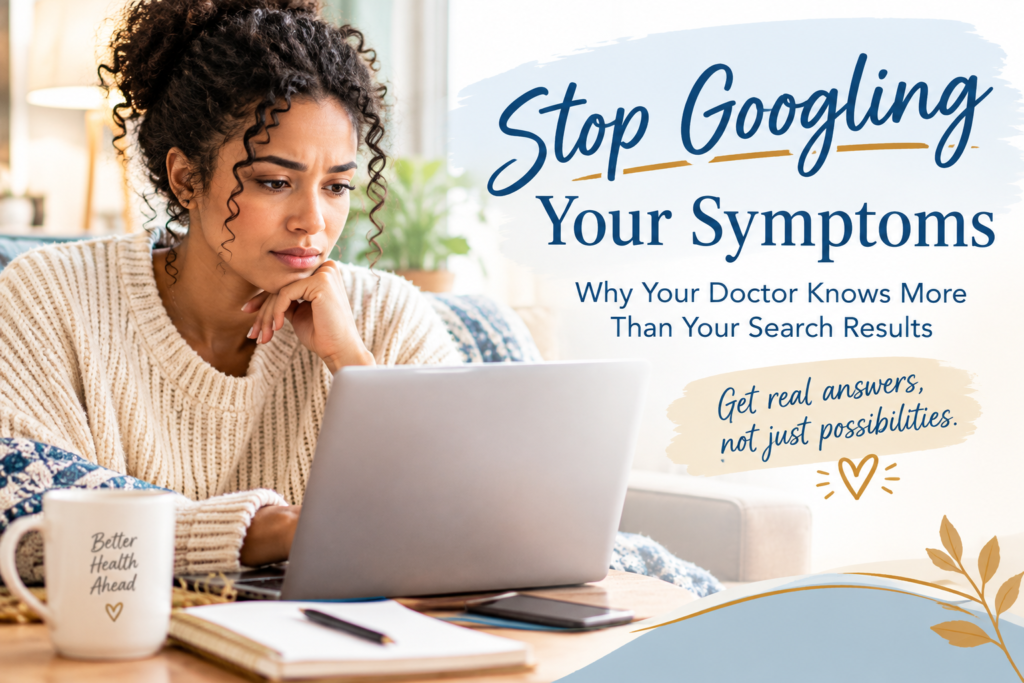
Stop Googling Your Symptoms: Why Your Doctor Knows More Than Your Search Results
It started with a headache.
Nothing dramatic. Nothing that seemed particularly alarming.
But like most of us, she did what felt completely natural. She reached for her phone.
“Headache for three days.”
Within seconds, she had an entire list of possibilities.
Dehydration. Stress. Sinus problems. Migraine. Blood pressure. Hormones.
And then, somewhere much farther down the list, something much scarier.
Suddenly, that little headache didn’t feel so little anymore.
By the time she finished scrolling, she wasn’t feeling better. She was worried.
Sound familiar?
We’ve All Been There
It is incredibly easy to search a symptom online.
A headache. A cough that won’t go away. Feeling unusually tired. A stomachache. Dizziness. A strange rash. A change in your sleep.
You type a few words into Google, and suddenly you have twenty possible explanations.
Some are harmless.
Some sound terrifying.
And unfortunately, the internet doesn’t know which one applies to you.
That is where things can get confusing.
Online symptom searches can be useful for general information, but they cannot take the place of a healthcare professional who can ask questions, review your medical history, examine you, and order or interpret tests when needed.
The Problem With Diagnosing Yourself Online
Let’s go back to our headache.
Imagine she arrives at the doctor’s office with screenshots from Google, convinced she has several different conditions.
Her doctor doesn’t start by looking at the search results.
Instead, she starts asking questions.
When did the headache begin?
Where exactly does it hurt?
Has it happened before?
How much water have you been drinking?
How have you been sleeping?
Have you been under more stress lately?
Are you taking any new medications or supplements?
Have you noticed anything else?
Suddenly, the picture starts to look very different.
The doctor isn’t just looking at one symptom.
She’s looking at the whole person.
That’s the part Google can’t do.
Your symptoms don’t exist in isolation. Your age, medical history, medications, lifestyle, recent changes, family history, physical examination, and other symptoms can all change what a symptom might mean.
And sometimes, what looks like one problem online may turn out to be something completely different once all the pieces are put together.
Google Isn’t the Enemy
Let’s be realistic.
We’re not going to stop using Google.
And you don’t necessarily need to.
Searching for general health information can actually be helpful. You might want to understand a medical term, learn more about a condition you’ve already been diagnosed with, or think of questions you’d like to ask at your next appointment.
Even AI tools can be useful for general health education and preparing questions for a healthcare visit.
The important part is knowing where the search should end.
Use the internet to learn. Don’t use it to diagnose yourself.
Before You Go Down the Internet Rabbit Hole
The next time something doesn’t feel right, try this instead of immediately searching for the scariest possibility.
Write down what you’re experiencing.
When did it start? Is it getting better, worse, or staying the same?
Pay attention to patterns.
Does something make the symptom better or worse? Does it happen at a particular time of day?
Think about recent changes.
Have you been sleeping differently? Eating differently? Taking a new medication or supplement? Experiencing more stress than usual?
Make a list of your medications and supplements.
This can be especially helpful when you’re speaking with your healthcare provider.
Write down your questions.
Instead of trying to diagnose yourself, bring your questions to your appointment.
And most importantly, don’t ignore something simply because you aren’t sure what it means.
You don’t have to figure it out before you call your doctor.
That’s part of what your doctor is there for.
Sometimes Peace of Mind Starts With a Conversation
Back to our patient with the headache.
After talking through everything, her doctor was able to put the pieces together and determine what needed attention and what didn’t.
She left with a plan.
More importantly, she left without the long list of frightening possibilities she’d found online.
And that is something a search engine can’t give you.
Context.
Your health deserves more than a list of possibilities.
The next time you find yourself three pages deep into Google trying to diagnose that strange symptom you’ve been ignoring, pause.
Take a breath.
Close the search.
Write down what you’re experiencing and talk to someone who can actually look at the whole picture.
Because you don’t have to figure it all out yourself.
Sometimes the best thing you can do for yourself is simply make the appointment.
At U-First Health and Wellness, we believe healthcare should feel like a conversation, not a guessing game. If something doesn’t feel right, we’re here to listen, help you understand what’s going on, and figure out what comes next.
Your health deserves more than a search result. It deserves real care.
📍 Waldorf, Maryland
📞 +240-514-2323
🌐 www.ufirsthealthonline.com
📱 @ufirsthealthonline